StoryTeller: Don Waller, a botanist at the University of Wisconsin, in Madison, US.
Source: Venus Flytrap origins uncovered
Story Research: The Lovable Venus Flytrap: A Design Analysis
 A musculoskeletal system so far unknown in the animal world was recently discovered in weevils. The hip of Trigonopterus oblongus does not consist of the usual hinges, but of joints based on a screw-and-nut system.Screws and nuts are known from engineering and used for the fixed connection of components. "Now, we found that nature was first in inventing screws and nuts, because weevils have been using this construction for about 100 million years already," Alexander Riedel from the Karlsruhe State Museum of Natural History says. This museum supplied the weevil samples studied. The detailed three-dimensional images of the joints were made at the national ANKA synchrotron radiation source of Karlsruhe Institute of Technology.
 Zoologists Malcolm Burrows and Gregory Sutton at the University of Cambridge, UK, say that this seems to be the first example in nature of rotary motion with toothed gears. They describe their findings today in Science.
When the insect jumps, the cog teeth join so that the two legs lock together, ensuring that they thrust at exactly the same time (see video above and image at left). “The gears add an extra level of synchronization beyond that which can be achieved by the nervous system,” says Burrows.
Gears are not the only mechanical solutions that were long thought to be unique to human engineering and then found to have been mastered by evolution: The screw-and-nut system is another example. In 2011, Alexander Riedel of the State Museum of Natural History in Karlsruhe, Germany, and his colleagues reported a screw-thread joint in the legs of a weevil beetle
Zoologists Malcolm Burrows and Gregory Sutton at the University of Cambridge, UK, say that this seems to be the first example in nature of rotary motion with toothed gears. They describe their findings today in Science.
When the insect jumps, the cog teeth join so that the two legs lock together, ensuring that they thrust at exactly the same time (see video above and image at left). “The gears add an extra level of synchronization beyond that which can be achieved by the nervous system,” says Burrows.
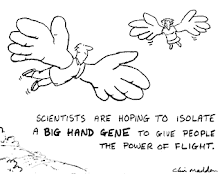
Gears are not the only mechanical solutions that were long thought to be unique to human engineering and then found to have been mastered by evolution: The screw-and-nut system is another example. In 2011, Alexander Riedel of the State Museum of Natural History in Karlsruhe, Germany, and his colleagues reported a screw-thread joint in the legs of a weevil beetle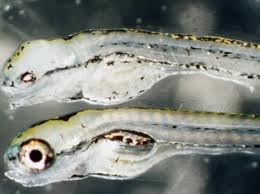 Researchers reporting in the December issue of the Cell Press journal Developmental Cell provide new evidence that the development of hands and feet occurred through the gain of new DNA elements that activate particular genes.


 According to the researchers an ancient jawbone showed that nature's largest mouths probably evolved to suck in large prey rather than to engulf plankton-filled water. The prehistoric jaw, was very different from modern baleen whales where the lower jaw does not fuse at the "chin". Instead there is a specialised jaw joint that allows each side of the jaw to rotate. By having two curved lower jaw bones that rotate in this way, baleen whales are able to produce huge gapes to take in massive quantities of water and prey.
 Females from a newly discovered "solitary" species build the perfect environment for their eggs according to scientist Jerome Rozen.
 According to Jon Mitchell from the University of Chicago, "A SET of 200-million-year-old teeth from a beast related to dinosaurs and crocodiles has shed light on how snake fangs evolved. They support the idea that venom canals inside fangs evolved from grooves on the tooth surface." Jon and his colleagues discovered 26 Uatchitodon teeth that shows how grooves initially formed at the surface and gradually lengthened and deepened until they became enclosed canals. Bryan Grieg Fry from the University of Melbourne, Australia, is convinced this is the case, and says the fossil series is "fantastic".
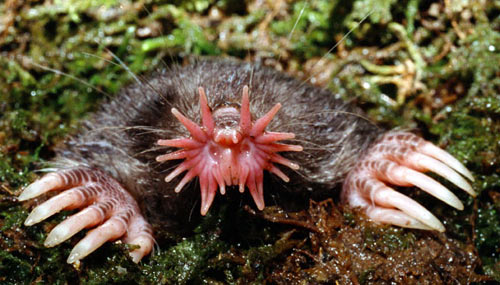 This weird and wonderful creature is the star-nosed mole. It relies heavily on its remarkable star-shaped nose. This organ enables the star-nosed mole to decide whether something is edible with astonishing speed. The star-shaped nose is a highly specialized sensory-motor organ, which consists of 11 pairs of fleshy finger-like 'tendrils'. The star is divided into a high resolution central fovea region and less sensitive peripheral areas. its surface is covered with 25,000 mechanoreceptors called Eimer's organs. This makes the star ultrasensitive - it is, in fact, the most sensitive organ in the entire animal kingdom.
 According to researchers from the University of Texas, the jewel scarab species Chrysina gloriosa can distinguish between circularly polarized and unpolarized light. That ability could provide the beetles with a tremendous advantage, the researchers say, because most of the light reflected off these beetles’ colorful bodies happens to be circularly polarized. Because ability to see CP light is very rare in nature, it’s not likely that any of the beetles’ predators can see it. So the ability to both see and reflect CP light probably evolved to allow jewel scarabs to communicate with each other while staying hidden from predators

 According to New Scientist, "It's one of evolution's most eccentric creations: a head shaped like a hammer. Now, a study suggests that the hammerhead shark may have evolved its oddly shaped snout to boost the animal's vision and hunting prowess."
 ScienceDaily - Naked mole rats are strange, ugly, nearly hairless mouse-like creatures that live in underground communities. Unlike any other mammal, these communities consist of queens and workers more reminiscent of bees than rodents
 Lust is a universal preoccupation, one of the most compelling of the Seven Deadly Sins, new studies confirm. Whereas not only humans, but also birds and mammals, regularly engage in promiscuous, lecherous behaviour, researchers report that only people are capable of controlling such urges.
 Scientists have discovered that the spleen, long consigned to the B-list of abdominal organs and known as much for its metaphoric as its physiological value, plays a more important role in the body’s defense system than anyone suspected.
 A new study published February 17 in the journal PLoS One by researchers from Ohio University, College of the Holy Cross and the University of Leicester explains how balloon-like air sacs, which extended from the lungs to inside the skeleton of pterosaurs, provided an efficient breathing system for the ancient beasts. The system reduced the density of the body in pterosaurs, which in turn allowed for the evolution of the largest flying vertebrates.
 A new study reports that seed beetles may be seeking out intimate moments not to increase their chances of becoming fertilized, but for hydration. "We were curious about the behavior of these females—males are known to inflict damage during mating, and yet the females keep going back for more," said study lead author Claudia Ursprung.
 LONDON: Anthropologists have suggested that Neanderthals had big noses because of the degree to which their face used to jut forward, indicating that the odd feature was a fluke of evolution, not some grand adaptation. The Neanderthal nose has been a matter of befuddlement for anthropologists, who point out that modern cold-adapted humans have narrow noses to moisten and warm air as it enters the lung, and reduce water and heat loss during exhalation. Big noses tend to be found in people whose ancestors evolved in tropical climates
 A newly identified fossil could explain one of evolution's biggest mysteries – the origin of the turtle's shell. Bone fragments from a 210-million year-old, land-dwelling reptile from New Mexico suggest that the earliest turtles didn't have much of a shell at all. Over millions of years, rows of protective armour plates gradually fused together and to the reptile's vertebrae, eventually creating a complete shell. "Turtles ultimately originated from something that looked like an armadillo," says lead author Walter Joyce.




.jpg)


 Posts
All Comments
Posts
All Comments